
Over 10 years we helping companies reach their financial and branding goals. Onum is a values-driven SEO agency dedicated.

CONTACTS
Real Estate

How Much Investment is Required to Start a Real Estate Business?

Table of Contents

Learn how much investment is required to start a real estate business in India. Explore startup costs, land acquisition, RERA, financing, legal fees, and budgeting tips.

Starting a real estate company is one of the most rewarding business opportunities in today’s market. Whether you dream of becoming a property developer, launching your own brokerage, investing in rental properties, or building residential and commercial projects, one question always comes first:

How Much Investment is Required to Start a Real Estate Business?

The answer isn’t as straightforward as quoting a single figure. Your total Real Estate Business Investment depends on several factors, including your chosen business model, project size, location, legal requirements, financing options, and long-term business goals.

For example, someone starting a Real Estate Brokerage Model can begin with an investment of ₹3–10 lakh, while a Real Estate Development Business involving land acquisition and construction may require anywhere from ₹50 lakh to several crores. Likewise, investors entering Residential Real Estate Investment typically need less capital than those developing large Commercial Real Estate Investment projects.

Understanding your Initial Capital Requirement before investing is essential. Many first-time entrepreneurs underestimate hidden expenses such as Business Registration Cost, Legal Documentation, Building Approval Fees, Marketing and Advertising Budget, and Operational Expenses, only to face cash flow problems later.

The good news is that modern financing options have made entering the industry more accessible. Entrepreneurs can now leverage a Business Loan for Real Estate, explore Project Financing, attract private investors, or partner through Joint Venture (JV) Development models to reduce upfront investment.

This guide provides a detailed breakdown of every major expense involved in launching a real estate business in India. From Land Acquisition Cost and Construction Cost to Working Capital Requirement, Property Development Cost, compliance, marketing, and growth planning, you’ll gain a realistic understanding of where your money goes and how to plan effectively.

Whether you’re a beginner with a modest budget or an experienced investor planning a large-scale project, this article will help you estimate costs, avoid common mistakes, and create a profitable strategy from day one.


How Much Investment is Required to Start a Real Estate Business?

There is no universal investment amount because the industry offers multiple business opportunities, each requiring a different level of capital.

Here is a realistic estimate based on common business models in India.

Business Type Estimated Investment
Property Consultant / Brokerage ₹3–10 Lakh
Small Property Investment ₹10–30 Lakh
Rental Property Business ₹20–75 Lakh
Residential Builder ₹50 Lakh–₹5 Crore+
Commercial Real Estate Development ₹2 Crore–₹100 Crore+

These figures include more than just buying property. A comprehensive Property Investment Budget should account for:

  • Business Registration Cost
  • Company Registration
  • GST Registration
  • RERA Registration (where applicable)
  • Office infrastructure
  • Technology and software
  • Employee salaries
  • Marketing
  • Legal and compliance expenses
  • Emergency reserves

A common mistake among new entrepreneurs is focusing only on property purchase while overlooking day-to-day operating costs. Successful businesses prepare for both one-time investments and recurring expenses from the beginning.


Why Investment Varies from One Business to Another

Several factors influence your overall startup budget.

1. Business Model

The type of business you choose has the biggest impact on your investment.

A real estate consultant primarily invests in branding, office setup, marketing, and networking, whereas a developer must purchase land, obtain approvals, hire contractors, and manage construction.

For instance:

  • A brokerage firm may require only a small office and a marketing budget.
  • A property developer must invest heavily in land, construction, approvals, and infrastructure before earning revenue.

This difference explains why startup costs vary so widely across the industry.


2. Location Matters

Property prices differ significantly across cities.

Purchasing land in Mumbai, Bengaluru, or Delhi requires substantially more capital than investing in emerging Tier-2 or Tier-3 cities.

Before buying land, conduct detailed Market Research and Location Analysis to evaluate:

  • Infrastructure growth
  • Connectivity
  • Population trends
  • Demand
  • Future appreciation potential
  • Government development projects

Smart location selection often produces better returns than simply buying expensive land.


3. Scale of Operations

Starting with a single apartment project requires much less investment than launching an integrated township.

Your project size directly affects:

  • Land Acquisition Cost
  • Property Development Cost
  • Infrastructure Development Cost
  • Labor costs
  • Construction timeline
  • Financing requirements

Many successful developers begin with smaller projects before expanding into larger developments.


4. Construction Quality

Your chosen construction standards significantly influence the overall Construction Cost.

Premium materials, smart-home technologies, luxury interiors, and sustainable building practices increase initial investment but may also improve property value and buyer demand.

Developers should balance quality with target market expectations to maximize profitability.


5. Government Regulations

Every real estate project must comply with local regulations.

Costs may include:

  • Building Approval Fees
  • Municipal permissions
  • Environmental clearances
  • Fire safety approvals
  • Utility connections
  • Builder License
  • Land-use approvals

Ignoring compliance can lead to costly delays, penalties, or even project cancellation.


Factors That Determine Your Real Estate Business Investment

Let’s examine the major cost categories that shape your startup budget.


1. Land Acquisition Cost

For most developers, purchasing land is the single largest expense.

The total Land Acquisition Cost includes:

  • Purchase price
  • Broker commission
  • Legal verification
  • Survey charges
  • Registration fees
  • Government taxes
  • Mutation charges

Never purchase land without proper legal verification. Spending on Due Diligence Cost upfront can prevent disputes and financial losses later.

Professional due diligence typically covers:

  • Title verification
  • Ownership history
  • Encumbrance checks
  • Zoning compliance
  • Litigation search
  • Government acquisition status

Skipping these checks can turn an attractive investment into a long-term liability.


2. Legal Registration and Compliance Costs

Every legitimate business should begin with proper legal registration.

Typical compliance expenses include:

  • Company Registration
  • GST Registration
  • RERA Registration (for applicable projects)
  • Trademark registration (optional)
  • Professional licenses
  • Digital signatures
  • Chartered Accountant fees
  • Legal consultation

These registrations not only ensure compliance but also enhance credibility with customers, banks, and investors.

A registered company finds it easier to secure financing, attract business partners, and participate in larger development opportunities.


3. Stamp Duty and Registration Charges

Many entrepreneurs overlook government transaction costs while budgeting.

Your investment should also include:

  • Stamp Duty and Registration Charges
  • Property registration fees
  • Government cess
  • Transfer charges

These charges vary by state and property type and should be calculated before finalizing any purchase.


4. Land Conversion and Project Approvals

If agricultural land is being converted into residential or commercial use, additional approvals are required.

Typical expenses include:

  • Land Conversion Charges
  • Development permissions
  • Utility approvals
  • Local authority clearances
  • Environmental permissions

Along with these, every project follows a structured Project Approval Process, involving multiple government departments before construction can legally begin.

Proper planning reduces approval delays and minimizes unexpected expenses.


5. Property Valuation

Before purchasing land or securing financing, obtaining a professional Property Valuation is highly recommended.

A certified valuation helps you:

  • Determine fair market value.
  • Avoid overpaying for land.
  • Negotiate better deals.
  • Support bank loan applications.
  • Estimate future returns.

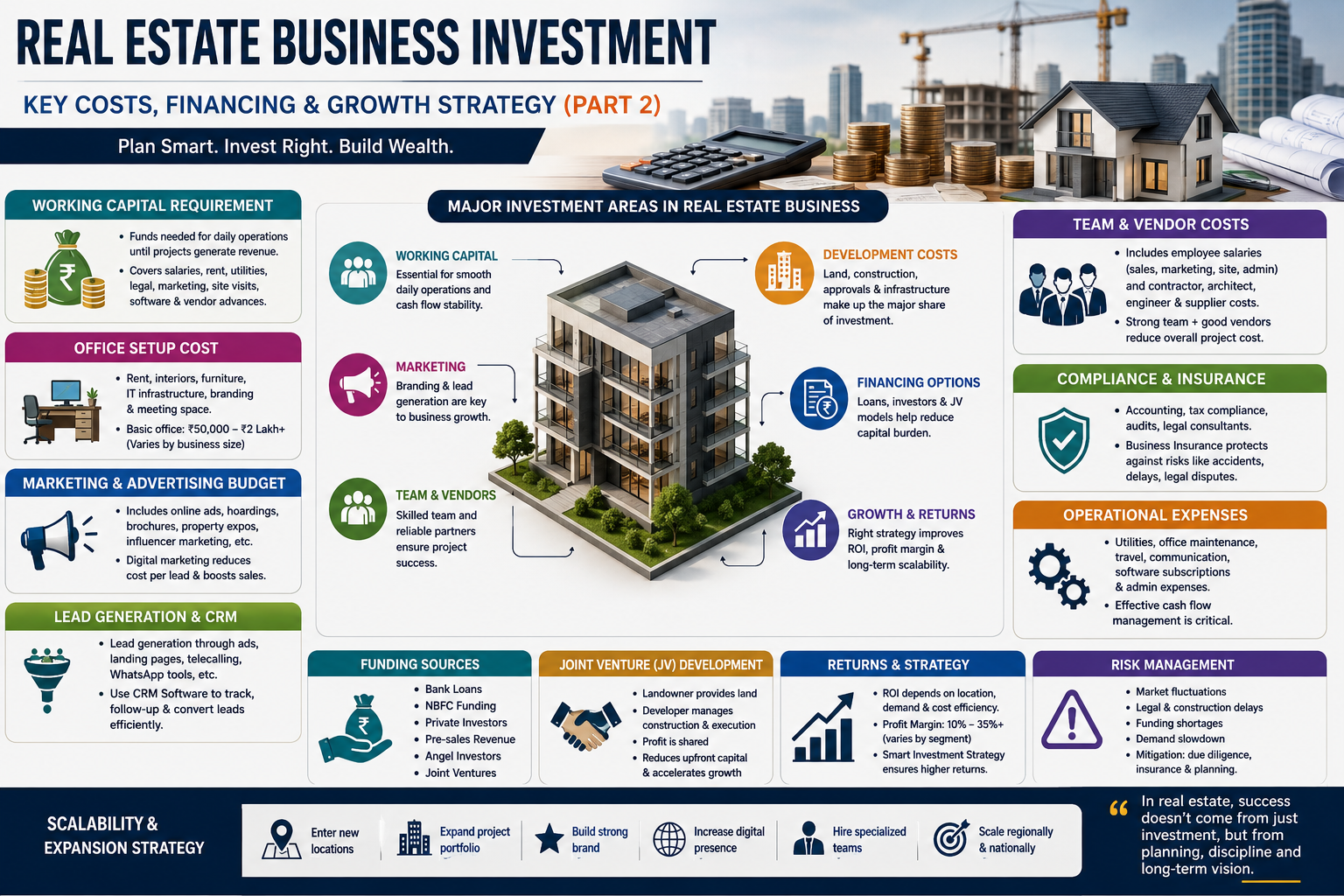
    Working Capital Requirement in Real Estate Business

    One of the most ignored but critical parts of Real Estate Business Investment is the Working Capital Requirement.

    Working capital is the money you need to run daily operations until your projects start generating revenue. In real estate, cash flow cycles are long, so proper planning is essential.

    It typically includes:

    • Staff salaries
    • Office rent and utilities
    • Legal and compliance payments
    • Marketing campaigns
    • Site visits and travel
    • Software subscriptions
    • Vendor advance payments

    Without proper working capital planning, even profitable businesses face cash shortages.

    For example, a small Real Estate Development Business may need ₹5–15 lakh monthly working capital depending on project size and staff strength.


    Office Setup Cost and Infrastructure Planning

    To run a professional real estate company, you need a physical or hybrid office setup. This is part of your Startup Cost Estimation.

    Key expenses include:

    • Office Setup Cost (rent, deposit, interiors)
    • Computers, internet, and IT systems
    • Furniture and meeting space
    • Branding materials
    • Site visit coordination setup

    A basic brokerage office may start with ₹50,000–₹2 lakh setup cost, while a development company may invest significantly more.

    A professional office increases trust, especially in Residential Real Estate Investment and Commercial Real Estate Investment, where clients expect credibility.


    Marketing and Advertising Budget in Real Estate

    Marketing is not optional in real estate—it is the engine of lead generation.

    Your Marketing and Advertising Budget depends on your growth stage and business model.

    It typically includes:

    • Online ads (Google & Meta)
    • Offline branding (hoardings, banners)
    • Brochures and catalogs
    • Property expos
    • Influencer marketing
    • Walk-in campaigns

    A strong strategy using Digital Marketing for Real Estate can significantly reduce cost per lead compared to traditional marketing.


    Lead Generation Cost and CRM Systems

    Every real estate business depends on leads. But generating quality leads comes at a cost.

    Your Lead Generation Cost may include:

    • Paid ads
    • Landing pages
    • Lead forms
    • Telecalling teams
    • WhatsApp automation tools

    To manage these leads effectively, companies use CRM Software.

    A good CRM helps you:

    • Track buyer interest
    • Automate follow-ups
    • Manage site visits
    • Improve conversion rates
    • Analyze sales performance

    Without CRM, most leads get lost, directly impacting revenue.


    Hiring Team and Vendor Management Costs

    As your business grows, human resources become a major cost factor.

    Employee Hiring Cost includes:

    • Sales executives
    • Site managers
    • Marketing staff
    • Admin team
    • Legal advisors

    In addition, every project involves external partners such as:

    • Contractors
    • Architects
    • Engineers
    • Suppliers

    These are part of Vendor and Contractor Costs, which fluctuate depending on project size and construction quality.

    Strong vendor relationships help reduce overall Property Development Cost.


    Accounting, Compliance, and Business Insurance

    Running a real estate business requires strict financial discipline.

    You must consider:

    • Accounting and Tax Compliance (GST filings, audits, TDS)
    • Financial reporting systems
    • Chartered accountant fees
    • Legal consultants

    Additionally, Business Insurance protects against risks such as:

    • Construction delays
    • Fire or natural damage
    • Legal disputes
    • Liability claims

    Proper compliance ensures smooth approvals and builds investor trust.


    Operational Expenses in Real Estate Business

    Beyond project costs, you must manage ongoing Operational Expenses such as:

    • Utilities
    • Office maintenance
    • Software subscriptions
    • Travel and communication
    • Administrative overheads

    These recurring costs directly impact your monthly cash flow, making Cash Flow Management extremely important.

    Poor cash flow planning is one of the top reasons real estate startups fail.


    Financing Options for Real Estate Entrepreneurs

    Not every entrepreneur has full capital upfront. That’s where financing comes in.

    Business Loan for Real Estate

    Banks and NBFCs offer structured loans for developers and brokers based on eligibility and credit profile.

    Project Financing

    Large projects are often funded through structured Project Financing, where lenders fund based on project feasibility and future revenue.

    Bank Loan Eligibility

    Your eligibility depends on:

    • Credit score
    • Business history
    • Collateral
    • Project viability
    • Cash flow projections

    Funding Sources

    Common funding options include:

    • Bank loans
    • NBFC funding
    • Private investors
    • Pre-sales revenue
    • Angel investors
    • Joint ventures

    Joint Venture (JV) Development Model

    One of the most powerful strategies in real estate is Joint Venture (JV) Development.

    In this model:

    • Landowner provides land
    • Developer provides construction and execution
    • Profit is shared

    This reduces the need for heavy upfront capital and is widely used in India.

    It is especially useful for new developers who want to enter the market with limited funds.

    How Much Investment is Required to Start a Real Estate Business?


  • ROI, Profit Margin, and Investment Strategy

    Understanding returns is as important as understanding costs.

    Return on Investment (ROI)

    Real estate ROI depends on:

    • Location growth
    • Project demand
    • Cost efficiency
    • Sales strategy

    Profit Margin in Real Estate

    Margins vary:

    • Brokerage: 2–5%
    • Residential projects: 10–25%
    • Commercial projects: 15–35%

    Investment Strategy

    A strong Investment Strategy includes:

    • Diversification
    • Phased development
    • Market timing
    • Risk control

    Risk Management in Real Estate

    Every real estate project carries risks such as:

    • Market fluctuations
    • Legal delays
    • Construction delays
    • Funding shortages
    • Demand slowdown

    Effective Risk Management includes:

    • Proper due diligence
    • Legal verification
    • Financial planning
    • Insurance coverage
    • Conservative budgeting

    Scalability and Expansion Strategy

    Once your business stabilizes, the next step is growth.

    A strong Scalability and Expansion Strategy includes:

    • Entering new cities
    • Expanding project sizes
    • Building brand authority
    • Increasing digital presence
    • Hiring specialized teams

    Successful developers don’t stay local—they scale regionally and nationally.

    Complete Investment Summary: How Much Investment is Required to Start a Real Estate Business?

    By now, you’ve seen that there isn’t a one-size-fits-all answer to How Much Investment is Required to Start a Real Estate Business? The total investment depends on your business model, project scale, target market, and long-term vision.

    A small Real Estate Brokerage Model can often be launched with a relatively modest budget focused on branding, office infrastructure, and marketing. In contrast, a Real Estate Development Business requires significantly more capital because it involves land acquisition, approvals, construction, labor, and ongoing project management.

    Instead of asking, “How much money do I need?”, successful entrepreneurs ask:

    • What business model fits my budget?
    • How will I finance my project?
    • What are my expected returns?
    • How will I manage risks and cash flow?
    • Can my business scale in the future?

    Answering these questions early helps you build a financially sustainable business rather than simply starting one.


    Estimated Cost Breakdown to Start a Real Estate Business

    The following table provides an estimated investment range for different business components. Actual costs vary based on city, project size, and business model.

    Expense Category Estimated Cost (INR)
    Company Registration & Compliance ₹20,000 – ₹1,00,000
    GST & RERA Registration ₹10,000 – ₹75,000
    Legal Documentation & Due Diligence ₹50,000 – ₹5,00,000
    Office Setup Cost ₹50,000 – ₹10,00,000+
    CRM Software & Technology ₹20,000 – ₹2,00,000/year
    Marketing & Advertising Budget ₹1,00,000 – ₹20,00,000+
    Employee Hiring Cost ₹2,00,000 – ₹25,00,000/year
    Land Acquisition Cost Varies from Lakhs to Crores
    Construction Cost ₹1,500 – ₹4,500 per sq. ft. (approx.)
    Building Approval Fees Depends on project location
    Property Development Cost Based on project scope
    Vendor & Contractor Costs Project-specific
    Operational Expenses Monthly recurring cost
    Working Capital Requirement 6–12 months of operating expenses
    Business Insurance Varies by project value

    Tip: Always maintain an emergency reserve of at least 10–20% of your total project cost to handle unexpected delays or cost overruns.


    Real-Life Investment Example

    Let’s understand the investment with a practical example.

    Scenario: Small Residential Project in a Tier-2 City

    Rahul wants to start a small residential development project consisting of six independent builder floors.

    His estimated investment plan looks like this:

    Expense Approximate Cost
    Land Purchase ₹60 Lakh
    Legal & Registration ₹3 Lakh
    Approvals & Licenses ₹5 Lakh
    Construction ₹1.2 Crore
    Marketing ₹10 Lakh
    Office & Administration ₹7 Lakh
    Working Capital ₹15 Lakh
    Contingency Reserve ₹20 Lakh

    Total Estimated Investment: ₹2.4 Crore

    Instead of investing the entire amount personally, Rahul structures the project as follows:

    • 30% personal investment
    • 40% bank loan
    • 30% through investor participation

    This balanced funding strategy reduces financial pressure while maintaining ownership and project control.


    Smart Ways to Reduce Initial Investment

    Many first-time entrepreneurs believe they need several crores before entering the real estate industry. In reality, there are several ways to start with a lower investment.

    1. Begin with Real Estate Brokerage

    Starting as a property consultant allows you to understand the market without purchasing land or investing in construction.

    It also helps you:

    • Build industry connections
    • Understand customer needs
    • Generate regular commissions
    • Create a strong client database

    Many successful developers started their careers as brokers before moving into development.


    2. Choose Joint Venture (JV) Projects

    A Joint Venture (JV) Development allows developers to partner with landowners instead of purchasing land outright.

    In a typical JV model:

    • The landowner contributes the land.
    • The developer manages approvals, construction, and sales.
    • Both parties share profits based on agreed terms.

    This approach significantly reduces your initial capital requirement while allowing you to undertake larger projects.


    3. Leverage Business Loans and Project Financing

    You don’t always need to finance an entire project yourself.

    Options include:

    • Business loans from banks
    • NBFC financing
    • Project-specific funding
    • Private investors
    • Strategic business partners

    Before applying, ensure your business plan includes realistic financial projections, cash flow estimates, and market research.


    4. Invest in High-Growth Locations

    The success of a real estate project often depends more on location than on luxury features.

    Before making an investment:

    • Study infrastructure projects.
    • Analyze future metro connectivity.
    • Review employment growth.
    • Evaluate population expansion.
    • Compare historical property appreciation.

    Choosing an emerging location can deliver higher returns with a lower entry cost compared to already saturated markets.


    5. Focus on Digital Marketing

    Instead of spending heavily on traditional advertising, allocate a significant portion of your budget to digital channels.

    Effective strategies include:

    • Search Engine Optimization (SEO)
    • Google Ads
    • Social media advertising
    • Video marketing
    • Email campaigns
    • Local SEO
    • Content marketing

    Digital marketing offers measurable results and often generates higher-quality leads at a lower cost.


    Common Mistakes That Increase Investment Costs

    Many new entrepreneurs overspend because they fail to plan properly.

    Avoid these common mistakes:

    Buying Land Without Due Diligence

    Never purchase land without verifying ownership, title, zoning regulations, and legal status.

    A small investment in legal verification can save years of litigation.


    Underestimating Construction Costs

    Material prices and labor costs fluctuate regularly.

    Always include a contingency reserve in your budget to absorb price increases.


    Ignoring Working Capital

    Many projects stall because developers invest everything into construction without maintaining sufficient cash reserves for daily operations.

    Working capital is essential for sustaining business continuity.


    Poor Cash Flow Management

    Even profitable projects can fail if cash inflows and outflows are not managed effectively.

    Prepare monthly cash flow projections and monitor expenses regularly.


    Weak Marketing Strategy

    A completed project still needs buyers.

    Without a structured marketing plan, inventory remains unsold, increasing holding costs and reducing profitability.


    Lack of Risk Planning

    Every project involves uncertainty.

    Developers should prepare for:

    • Construction delays
    • Regulatory changes
    • Market fluctuations
    • Rising material costs
    • Financing challenges

    Proactive planning minimizes financial losses and improves long-term business stability.


    Final Thoughts

    Starting a real estate business is not just about arranging funds—it’s about making informed financial decisions.

    Whether you plan to become a broker, investor, or developer, success depends on thorough planning, legal compliance, strategic financing, and disciplined execution. Carefully estimating your startup costs, maintaining adequate working capital, and investing in the right location can significantly improve your chances of building a profitable and sustainable business.

    Rather than aiming to start big, focus on starting smart. Many successful real estate entrepreneurs began with small projects, built strong industry relationships, managed their finances wisely, and gradually expanded their portfolios over time.

    If you approach your investment with realistic budgeting, sound market research, and a long-term growth strategy, your real estate business can become a valuable and scalable asset for years to come.

    Frequently Asked Questions (FAQs)1. How much investment is required to start a real estate business in India?

    The investment depends on your business model. A Real Estate Brokerage Model may require ₹3–10 lakh, while a Real Estate Development Business can require anywhere from ₹50 lakh to several crores. Your total budget should include land acquisition, registration, construction, marketing, and working capital.


    2. Can I start a real estate business with a low investment?

    Yes. You can start as a real estate consultant or broker with a relatively small investment. This model mainly requires business registration, office setup, marketing, and networking rather than purchasing property.


    3. What is the biggest expense in a real estate business?

    For developers, the Land Acquisition Cost and Construction Cost are usually the largest expenses. For brokers, marketing, office infrastructure, and lead generation are the primary costs.


    4. Is RERA registration mandatory for every real estate business?

    No. RERA Registration is generally required for eligible real estate projects under the applicable state RERA rules. Brokers and developers should verify the specific requirements in their state before starting operations.


    5. How much working capital should I keep?

    Experts generally recommend maintaining at least 6–12 months of Working Capital Requirement to cover salaries, rent, utilities, marketing, and other operational expenses.


    6. Can I get a business loan for a real estate business?

    Yes. Many banks and NBFCs offer a Business Loan for Real Estate if you meet their Bank Loan Eligibility criteria, such as a good credit profile, viable business plan, and supporting documentation.


    7. What documents are required to start a real estate business?

    Common documents include:

    • Company Registration documents
    • PAN and Aadhaar
    • GST Registration
    • Business bank account
    • Legal Documentation
    • RERA Registration (if applicable)
    • Property-related approvals

    8. How do I estimate my startup budget?

    Prepare a detailed Startup Cost Estimation by listing every expense, including registration, office setup, land acquisition, construction, marketing, staffing, insurance, taxes, and contingency funds.


    9. What is the difference between residential and commercial real estate investment?

    Residential Real Estate Investment focuses on homes, apartments, and villas, while Commercial Real Estate Investment includes offices, retail spaces, warehouses, and commercial complexes. Commercial projects often require higher investment but may offer stronger rental income potential.


    10. Is digital marketing necessary for real estate businesses?

    Absolutely. Digital Marketing for Real Estate helps attract targeted buyers through SEO, Google Ads, social media marketing, email campaigns, and local search optimization, often at a lower cost than traditional advertising.


    11. Why is market research important before investing?

    Market Research helps you understand buyer demand, property prices, competition, future infrastructure developments, and investment opportunities before committing capital.


    12. How important is location analysis?

    Location Analysis is one of the most critical factors in real estate. A well-chosen location can significantly improve property appreciation, rental income, and overall Return on Investment (ROI).


    13. Should I use CRM software in my real estate business?

    Yes. A good CRM Software helps manage leads, automate follow-ups, schedule site visits, track sales, and improve customer relationships, increasing overall conversion rates.


    14. What are the major operational expenses in a real estate business?

    Typical Operational Expenses include office rent, employee salaries, utilities, software subscriptions, travel, marketing, accounting, insurance, and administrative costs.


    15. What are the risks of starting a real estate business?

    Common risks include:

    • Market fluctuations
    • Construction delays
    • Legal disputes
    • Rising material costs
    • Cash flow shortages
    • Regulatory changes

    Effective Risk Management helps reduce these challenges.


    16. What is a Joint Venture (JV) in real estate?

    A Joint Venture (JV) Development is a partnership where one party provides land while another manages development and construction. Both parties share profits based on agreed terms, reducing upfront investment.


    17. How can I improve my return on investment?

    You can improve your Return on Investment (ROI) by selecting high-growth locations, controlling construction costs, using effective marketing, managing cash flow efficiently, and pricing properties competitively.


    18. How profitable is a real estate business?

    The Profit Margin in Real Estate varies depending on project type, location, and market conditions. Well-managed residential and commercial projects can generate attractive long-term returns, although profitability is never guaranteed.


    19. How do I finance a large real estate project?

    Large developments are commonly financed through Project Financing, bank loans, private investors, joint ventures, or pre-sales. Choosing the right Funding Sources depends on your project size and financial position.


    20. What is the best strategy for scaling a real estate business?

    An effective Scalability and Expansion Strategy includes building a strong brand, expanding into new markets, investing in technology, hiring experienced professionals, and maintaining disciplined financial management.


    Final Conclusion

    Starting a real estate business requires more than just capital—it requires careful planning, financial discipline, and a long-term vision. Whether you’re launching a brokerage or developing large residential or commercial projects, understanding your investment requirements, legal obligations, financing options, and operational costs is the foundation of sustainable success.

    Rather than focusing solely on the amount of money needed, create a detailed business plan, conduct thorough market research, and build a realistic budget that accounts for both expected and unexpected expenses. Smart investments, strategic partnerships, and effective marketing can help you grow steadily while minimizing financial risks.

    As the real estate market continues to evolve, entrepreneurs who stay informed, embrace digital tools, and adapt to changing market trends will be better positioned to build profitable and scalable businesses.

    Follow Me on Instagram 

    For more info contact us

Author

Satyam

Leave a comment

Your email address will not be published. Required fields are marked *